

📅 2006CLASSIC ERA
The Classic Era Takes Shape
Games, personal spaces and the beginning of Habbo's golden age.
1 / 4
2006 · CLASSIC ERA
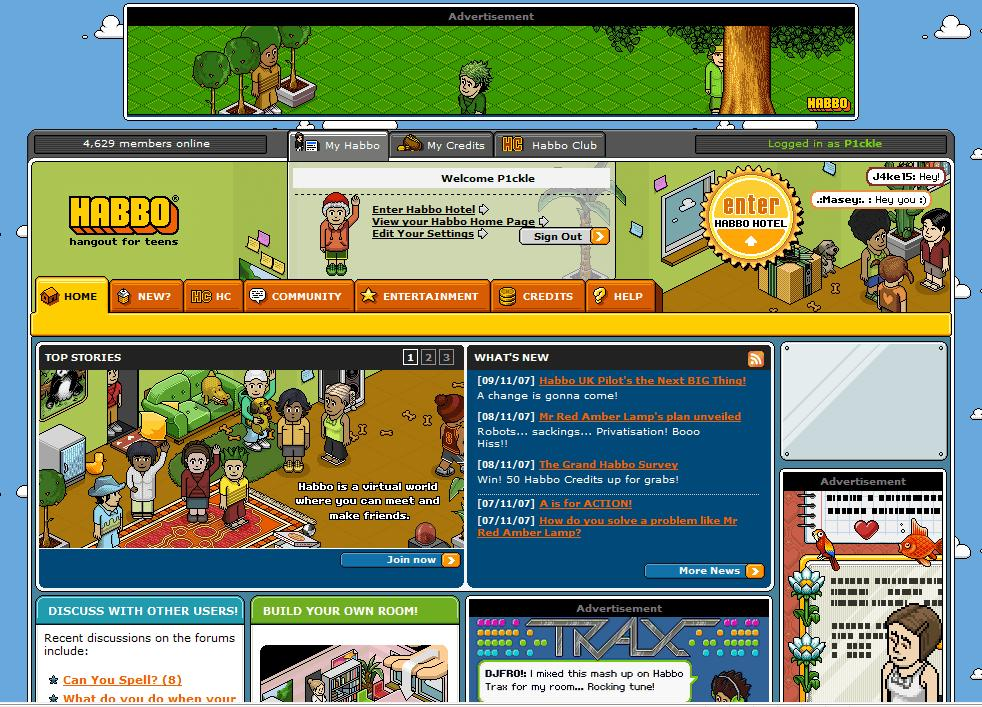
By 2006, Habbo had grown into a truly global network, but the experience was still unmistakably Old Habbo. Players spent their time building rooms, collecting furniture, trading rares and taking part in increasingly elaborate community events. At the same time, Sulake was beginning to give players more ways to make Habbo feel like their own.
The year brought another wave of international expansion. Brazil and Portugal launched in March, China followed in September, and Russia opened in October. Habbo was continuing to spread into new regions while maintaining separate communities for different languages and cultures.
One of the most memorable developments was Habbo Homes, introduced in October. For the first time, players could create their own personal profile pages outside their hotel rooms, decorating them with stickers, widgets and other custom elements. It was an early step toward the more personalised social features that would become increasingly important to Habbo.
Games were also becoming a major part of the experience. Battle Ball, introduced the previous year, was already one of Habbo's major competitive games, while SnowStorm arrived in late 2006. Based on Sulake's much older Finnish game Lumisota, SnowStorm let teams battle one another with snowballs in dedicated arenas. The first hotels received it toward the end of 2006, with other major hotels following in early 2007.
And then there was the rare market.
The summer of 2006 became famous among veteran Habbo players for an enormous boom in rare furniture values. Demand for pieces such as the Club Sofa and Throne rose dramatically before the market eventually collapsed toward the end of August. The event became one of the earliest major examples of how Habbo's furniture economy could behave almost like a real market, with players buying, selling, speculating and watching rare values closely.
Community culture was growing alongside the furniture economy. Fansites, competitions and player-created events had become an established part of Habbo life. The 2006 World Cup was turned into an international Habbo campaign, while Pirates, Around the World in 80 Rooms, Halloween's Serpent of Doom and Christmas' Rasta Santa gave players reasons to participate in events throughout the year. On Christmas Day, every Habbo who logged in received a Christmas 2006 badge, one of the earliest occasions where a badge was awarded to such a huge portion of the community.
By the end of 2006, Habbo had become much more than a virtual hotel. Rooms were personal creations, furniture had real social and economic value, games created competition, fansites documented the community, and players were beginning to build an identity around their own online spaces.
For many veteran players, this period represents the heart of what made classic Habbo feel like classic Habbo.
📖
Era
2006